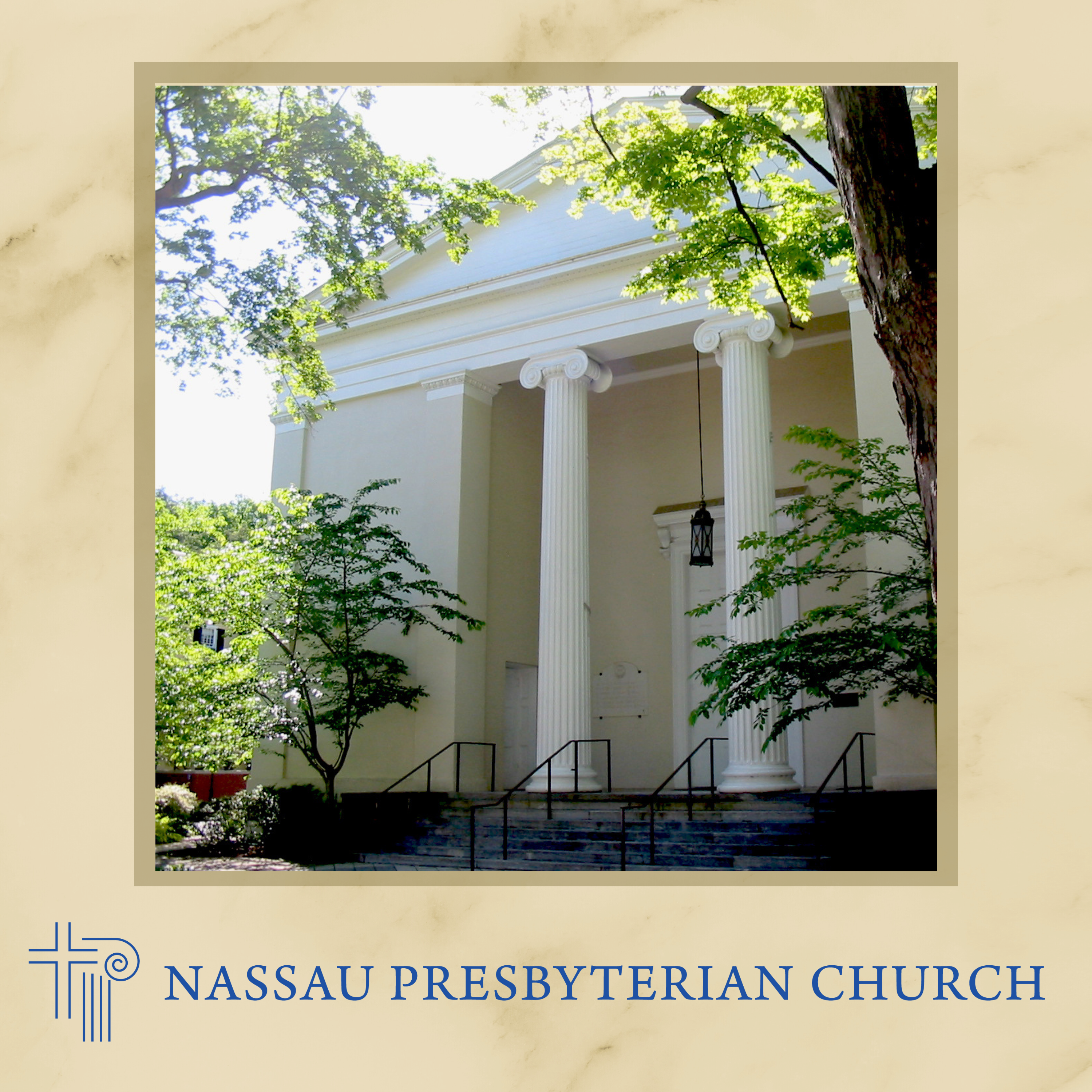
Episode Transcript
[00:00:01] Speaker A: Well, good morning.
Since the day is short and the kingdom of God is near, we're going to start 30 seconds early.
Welcome.
Welcome to Nassau Presbyterian Church. Just look around to each other and say happy New Year.
It really is an honor and a privilege to share our lives together.
This January, All Ages Journeys of Faith session has become a beloved tradition in which we get to hear from long time friends and members of our congregation who share something more of the inner side of their journey of faith.
Today we have the distinct privilege of welcoming a longtime member and friend.
Not member. That's right, pastor and friend.
For the record, Dave is the senior pastor at Nassau Presbyterian Church where he has served with us since the year 2000.
He earned his PhD in homiletics just down the street at Princeton Theological Seminary and taught there for several years as a visiting lecturer.
His scholarship focuses on the preaching on preaching as a corporate act and the active role that we as listeners play in the sermon.
Before coming to Princeton, he served for 14 years as pastor at First Prince Presbyterian Church in Blackwood, New Jersey.
Besides the many, many, many sermons, Dave is author of the Kingdom youm Can Taste and Lord, Teach Us to Pray. He served on the board of the Presbyterian foundation and the Princeton YMCA and has preached widely in the US and internationally, including in South Africa and Scotland, as well as the Calvin Symposium for worship on the campuses of Harvard and Duke.
A native of Pittsburgh and now this is the most important part.
Dave is married to Kathy Cook Davis, also a Presbyterian minister. They have two lovely children who grew up in this church, Hannah and Ben, and two grandchildren that we were delighted to see at our Christmas Eve services and who also are growing up in many ways at this church.
Franny and Maddie.
On a personal note, I would just say it has been an honor and a privilege to serve under Dave Davis.
Thank you, ladies and gentlemen.
Drumroll, Drumroll.
Ladies and gentlemen, I give to you our senior pastor, Dave Davis.
[00:02:58] Speaker B: Thank you. Thank you.
Thank you all for coming here today. I'm really humbled that everyone is here. It's a little bit intimidating. I've shared with a few people that I'm much more nervous baring my spiritual soul here than I would be in the pulpit.
At least I have the pulpit to protect me.
So here's my hope for today, that I could share some God moments in my life that have been transformative, what Pam Wakefield calls the God thing.
And that at the same time as you hear a little bit about my journey of faith to becoming a pastor, that I could demystify a pastor's call a little bit.
And so I'm going to share a little bit more of my human side as well, because in getting a call to ministry, I didn't hear any voices.
I didn't see any burning bushes.
There's no magic behind it. It's a pretty human thing. And I'm hopeful that this could demystify, especially for the younger people in the room, what it might mean to serve the church.
One of the struggles that I have is in the last 25 years, we've had many, many folks from Nassau Church go to seminary and be ordained and go into ministry.
All but one were seminarians first who then joined Nassau Church.
Kelly Roman, in 25 years, is the only indigenous member of Nassau Church to go into ministry.
The only one, yeah.
So let's begin with prayer.
Gracious and holy God, we give you thanks for the gift of the Lord's Day and for the privilege of sharing faith together.
Meet us in this room by the power of your spirit, in your holy and gracious name we pray.
Amen.
So I'm going to begin with a contemporary God moment, God thing, and then go back.
When I came to Nassau Church, I went and found a spiritual director.
I was 38 years old, came from a church of 110 members, had it grown to about 250 when I left.
And I went and found a spiritual director. His name was Hugh Smith, retired pastor.
Now, for Dave Davis, a spiritual director is not somebody who teaches you how to pray or does spiritual disciplines with you or you can imagine Loren McPheeters and I would have very different kinds of spiritual directors.
And what I needed was basically a pastoral therapist and support.
And I had two spiritual directors while I've been here. The first was Hugh Smith, a retired Presbyterian pastor who served in Ewing for years in Trenton.
And then Dave Prince.
And many of you know Dave Prince. He was retired and worshiping here.
Hugh Smith died while I was in his care.
Not like while I was there.
And then Dave Prince also passed away.
So then I was afraid to ask anybody else to be a spiritual director.
The spiritual director time for me was the only time in my life when I could spend an hour talking with somebody about not being a dad, not being a pastor, not being a husband, but being a beloved child of God.
And that's what that meaningful time was for me.
One time, soon after Hannah was accepted to college, she was accepted to Haverford. And back then, they still sent big envelopes.
And Hannah's acceptance came and she opened it when she got home from school. And she was so excited. And some things were falling out of this big envelope. She was going to go play soccer and run track, and she was so excited. Her top choice of a school.
One of the things that fell out onto the table was the financial aid package.
And I actually thought that the four numbers.
Four numbers was a code to go back to the FAFSA website and find out what they were really going to give.
I had a conversation with my spiritual director and I said, I don't know how I'm going to do this.
I don't know how we can afford to do this.
What am I supposed to do?
And he said to me, do you remember when you told me about how God has never let you down in the pulpit?
And that's true. And I've told students, and now almost 40 years of doing this, I've never had to say, noel, can we have a hymn sing today?
It's not that I hit it out of the park week after week after week, but God on the Sabbath rhythm of life and my preaching life has never, ever let me down, ever.
And Hugh Smith said to me, you know, if you can trust God in the Sabbath rhythms of life and your preaching life with that total amount of trust, maybe you should trust God with the harder things, he said, because I'm not sure there's a whole lot in Dave Davis life that you've really had to submit to God and to surrender.
My kids are both graduated, they don't have any financial debt, and we're doing just fine.
So Hugh Smith was right, and it was a God moment for me, a God thing.
I'm going to show some pictures. They're on the big screen and this screen to tell you a little bit about as we go back.
My spiritual journey begins with my parents, Bob and Jane Davis.
They grew up. They were high school sweethearts and grew up in the metropolis of Monongahela, Pennsylvania, along the Monongahela River. Both of their parents worked in the steel mills.
Growing up, we were not every Sunday churchgoers. We were members of the Presbyterian Church in Pleasant Hills, a suburb of Pittsburgh. But we didn't go every Sunday.
We went occasionally.
We didn't pray around our dining room table except on Thanksgiving and maybe Christmas.
My dad was an elder in the church. My mom had been a deacon. But it wasn't an everyday thing. We were something between Christmas and Easter, people and every week, people, something in between.
There I am.
I share this picture with you because I want to share another God moment, but not a really great God moment.
And that is that when I was nine years old, my brother Bobby, who's at that table, was killed in a car accident.
He was 21 years old.
Sunday morning, May 23, 1971, I will.
And looked out my bedroom window that I shared with my brother, my brother Tom, who's four years older than me.
And the cars that lined the street looked like we were having a party.
Soon later that morning, my mother and father came up to our room to tell us that our brother had been killed.
And what happened to me in that trauma.
Nine years old.
When you go to seminary, you have to take psychological testing. It's part of your preparation for ordination.
And they did some memory work with me. I have no memories before that moment.
Nine years old, and I have no memories of my brother Bobby.
And so I also wanted to share some artwork with you. He was an artist and a photographer.
That's Pittsburgh, circa late 1960s. That photograph is in our home. My brother took it.
This painting is in my office.
Some of you may have seen it.
My brother Bobby made that silk screen. And I asked my siblings if I could have it when I was leaving home. My parents gave it to me.
And I find the grammatical error rather enduring.
So what you've heard me say from the pulpit that my mother was the greatest theologian that I ever knew.
And it all began in watching her from a distance, deal with her grief and her anger when people would tell her it was God's will. And her not having any hesitation to tell them to go to hell.
And listening to her from outside the house wail, not just for days, not just for weeks.
My mother never got over my brother's death, but she never.
She was angry at God, but a relationship with God never stopped. And watching her find the strength was a God moment for me that lasted over decades.
And that trauma for me of not having any memories of my youth. Only thing I know about when I was little is what my brother and sister have told me. In fact, I had to write to them and text them to ask them what was the date of Bobby's death.
And as I said, I have no memories of him.
Fast forward. Oh, on that Sunday morning, the first pastor come down after the services were finished. To our house, the house full of people, was a pastor named Harry Freebairn.
Harry Freebairn then worked at the seminary for years.
And he'll be involved in another God moment you'll hear about in just a second.
I'm going to pick up the pace now.
I grew up not here.
These Pictures of Nassau are just Holder placeholders.
So I grew up in the Pleasant Hills Community Presbyterian Church, much like this church.
And my first memories of church are two things. One, listening to sermons, I can remember specific sermons from when I was very young.
And the second is singing in the children's choir and wearing my white surplus and having the choir moms put my hair down like that on my cowlick.
And I learned the faith from Bob Frazier, who was the music director at Pleasant Hills Church. The first scripture I learned was from Bob Frazier and the anthems that we would sing.
And then as I got older, confirmation was a life changing God moment for me. We had a full week long retreat for confirmation and it changed my life.
I don't use the language born again, but it was the start of what I understood to be my personal faith.
And then I became youth group every Sunday night. I became going to all the conferences and all of the, all of the weekend retreats that we did. And youth group became my life. This is my confirmation Bible that I have on my shelf.
And if you looked carefully, there was a time when I was leading a Bible study for the youth group. I felt so good about it when I was finished. I had my driver's license at the time I'm driving home. But as I was driving home, I realized the door wasn't shut. So I opened the door and then shut it, got home and realized I didn't have this Bible.
The Bible had been right here next to me and when I opened it, it fell out. So I went back, traced my roots and I found it along the side of a four lane highway.
And there's tire marks through this Bible.
And I keep it to help me to know because it was a God moment for me, that God wanted me to be a little more humble about my relationship and my gifts for leadership.
So much like many of you in the younger folks. My first sermon was Youth Sunday.
And all of the adults, including my pastors, would affirm my leadership in the church and they would affirm that I should consider going into ministry.
And was that affirmation? I was also a ruling elder when I was in high school.
So all the stuff that the young people in the room are familiar with is what influenced me to what I'm doing.
And I knew in high school that this is what I wanted to do because church and youth group was where I felt I was closest to God.
But there was also another part of my life.
Football was a pretty big part of my life and where football fits in for me. Is my best friends were in youth group. I wasn't cool enough to hang with the football.
And I was in a lot of AP classes. So the folks know, but the folks who are in AP classes aren't necessarily the on the football team.
And during my senior year, we were pretty good. And football in Western Pennsylvania is a big deal. I started a team chapel service at my church, and we would meet in.
And it started, you know, it started with a few folks, but we were also winning undefeated.
And at its peak, there were about 70 people coming to this worship service, including cheerleaders, coaches, and then we would go to the Blue Flame diner for breakfast. So the worship service was on at a Friday morning at 6am and then we would go.
We would go to breakfast and then go to school in our little ties.
Okay.
And here's another God thing. Not so great thing to learn.
We lost a game to Belvern in high school.
When I still go to Pittsburgh. I have to pass Belvern in high school.
And I even taught my kids. We roll down the window and we spit.
I still do it.
We lost the game next week, 15 people came to the service.
And God helped me to know that religion isn't about superstition after high school football.
And what that. Oh, I also was elected the most valuable player on the team, and I received the most valuable player on the team at the senior banquet. And the trophy was presented to me by a young rookie on the Pittsburgh Steelers whose name is Tony Dungy.
But I wasn't given the most valuable player award because I was the most valuable player.
It was about my leadership on the team, listening to guys being a different type of a leader. And that was another God moment for me and an affirmation of my leadership skills to lead people in a variety of different ways.
So that experience in football became an important part of my faith journey as well.
This is another placeholder from pandemic.
From a pandemic pageant. Yeah.
So I got recruited to go to Harvard, and back in the day.
Back in the day, freshmen weren't eligible to play varsity sports in the Ivy League. So I went to Harvard in the fall of 1980, and they recruit about 50 folks freshmen, and then they invite back about half for the varsity.
So this is just to prove to you that I actually did play football at Harvard.
I played for one year at Harvard, and then the coach and I came to a mutual decision and I gave up playing football and Harvard.
After I gave up football, then I went to sing in the choir at the University Church Memorial Church, which is that's Memorial Church on Harvard's campus, and listened to Peter Gomes, a great preacher, preach every Sunday. I was in the choir and got paid to go to church then, too.
And Peter taught me that preaching can be a literary event.
And in the choir we sang behind a rarity that's a liturgical screen.
And I would get furious looking at my colleagues in the choir pulling out the New York Times. While one of the best preachers in the country was climbing the steps to the pulpit, I was also involved in the Harvard Radcliffe Christian Fellowship. It was an intervarsity Christian Fellowship.
And I was more conservative back then, even as my church in Pittsburgh was more conservative certainly than Nassau Church. Most Presbyterian churches in Pittsburgh are more conservative than Presbyterian churches in other parts of the country.
But I went to InterVarsity Fellowship every Friday night.
And that was what that was a lifesaver for me because Harvard was a very difficult place for me to be, and I did not thrive at Harvard. I've thought about it a lot over the years and I've come up with two or three reasons. One is, and I can't speak for this campus, but at Harvard, the need to achieve is like a Maslovian pyramid. And it filters into everything of life because everybody who goes to a place like Harvard was a big fish academically.
But you can't all be big fish.
And so dating becomes intense.
Athletics becomes intense. Intramurals become intense. Trying out for a play becomes intense.
And the intensity where I would escape it was on Friday nights in this intervarsity Christian Fellowship where I once heard a lecture on the historicity of the Book of Jonah.
But it was a lifesaver to me, being a leader in that HRCF group.
But also the second reason that I realized that I didn't thrive at Harvard, and this took me years to understand, is that in truth, while I was there, I was an arrogant, moralistic, pious, Jesus loving jackass.
Did I add judgmental to that, too?
And so I absented myself from much of what could have been fun.
And I just hung out with the folks in my Christian fellowship. The other thing that I wrestled with is that I completely sucked at dqts. Does anyone know what a DQT is?
Daily quiet time.
And the leadership in the fellowship group. Daily quiet time. Daily quiet time. Daily quiet time. And I couldn't do it. I've never done it. I can't.
And it's just not a part of my personality. And it wasn't until years into the ministry and then back into the PhD program that a professor said going to Scripture to get up a sermon is going to Scripture in a pious, meditative way. It's serves your relationship with God. Because I would feel guilty that I only went to Scripture to get up a sermon, that there's a utilitarian version. So then it can't be pious, it can't feed my soul.
And of course, now the weeks I don't preach, my soul is like, ah.
So I graduated from Harvard in three years, mostly because of the AP courses I took in high school and that I wasn't going to have my parents spend another.
It would have been $16,000 room and board that year.
And all the pastors from my church in Pittsburgh went to Princeton Seminary. So I knew I was going to go to Princeton Seminary.
My senior pastor said, you need to try to talk yourself into doing something other than going into the ministry.
And if you can't, then you go into the ministry. I got a law school application but never filled it out. And I filled out one seminary application and came to Princeton Seminary.
A couple other influences for God moments for me. This book changed my life. I read it in high school, in college. Let Justice Roll down by John Perkins.
It's the beginning. It was the beginning of my complete transformation on race and understandings.
Back then the terms weren't white supremacy and anti racism, but that's what it was.
And I applied to go on an International Mission through InterVarsity. I applied to STEM student training and mission. And I wanted to go to.
I wanted to go to Zimbabwe.
They sent me to Jackson, Mississippi, which for a white kid from the suburbs of Pittsburgh was just as countercultural.
And I went to the Voice of Calvary Ministries, which was founded by John Perkins.
This book was published by intervarsity Press and clearly it's been republished because Shane Claiborne wasn't around when I was reading that book.
And I went and worked in an intentional community of black people and white people at Voice of Calvary. There were two pastors, a black pastor and a white pastor. And we lived together about 15 interns from around the country, college interns. And you've heard me say this from the pulpit.
The hardest thing about that summer was living with the 15 Christian kids from around the country.
But it was transformative for me in my faith and my relationship and my understanding of cultural differences.
It's the first time I'd overlived. It was first experience I ever had as being a minority, probably the last experience as a white man.
Another thing I did before I went to Seminary. The year between college and seminary is I went to do Christian ministry in the national parks.
Still exists. They send college students and seminarians to national parks. How that still exists, it baffles me.
But this is Glacier National Park. This is many Glacier Hotel in Glacier National Park.
I was a bellman. Kathy would tell you I was a bell boy. I was a bellman.
But please note the white shirts, black ties and lederhosen. There's knee socks as well.
And if I'm not going to leave this up long enough, but that's me there, and you can see my nice mustache.
But I led worship and preached every Sunday at various places in the park, including Christmas Eve in the park on July 24th.
And it was after that that I then went to Princeton Seminary.
Princeton Seminary became everything of an alma mater to me that Harvard never was. I have no friends from Harvard. I'm not in touch with any friends from Harvard except for an occasional Christmas card, but not more than two or three.
And Princeton Seminary became everything of an alma mater that I could imagine. And it still is with all the love and not so much love one has for his alma mater and my relationship with Scripture.
You know, sometimes when you go to seminary, you learn things that are a little, shake you up a bit.
Stuff like maybe Moses didn't write the Pentateuch or other, you know, other parts of Scripture.
Maybe Paul didn't write some of his epistles. For me, that did not rattle me at all. It only deepened my love of Scripture.
And I soaked up. Princeton Seminary went to chapel every.
Every day.
It's such a wonder to me, a mystery to me why more folks at seminary don't go to chapel every day.
Because there is never a time in one's life, whether you go into ministry or not, that you can go to chapel every day and worship.
And I went every day, Sang in the choir there, too. My best friends, my lifelong friends are from Princeton Seminary. I sucked up everything I could about preaching and of course, met Kathy.
I met Kathy at a.
At a Halloween party, a costume party in what was called the pits then. It's now the. Is it the Lenox House where the Bible folks. The fire. Is that the name of that, where the fire is?
And we were on that fire started on our anniversary. It burned a few years ago. So we took credit for the fire.
Another thing I wanted to tell you about my Jesus loving, arrogant, judgmental self is in my high school football team. There was a guy, thin receiver.
I was a linebacker and an offensive guard.
And they all knew and would make fun of my faith. And this guy would say in the locker room, Jesus Christ with an F word in between it just to, just to irritate me. So I did what any good loving young Christian boy would do. I took him with both my hands and shoved him as hard as I could up against the locker and threatened to punch him in the face. Good Christian thing to do.
After seminary.
I don't have much to say more about seminary because we all know so much about the seminary. But after seminary, then I was called to the First Presbyterian Church of Blackwood and that's the church.
And I wanted to be a solo pastor back then in 1986, most seminary graduates wanted to become associate pastors at large churches and then do the steeple climb, work your way up. And I wanted to preach, so I wanted to be a solo pastor.
And so in another God thing, I only interviewed at two churches, One in North Jersey and one in South Jersey and the one in North Jersey. I knew I was in trouble when they took me to a country club and I was the only one who didn't order a drink for the interview. It was kind of odd.
In Blackwood they took us into the fellowship hall and they had cheese and Velveeta on Ritz crackers. Velveeta on Ritz crackers. And I knew this is the place.
So we were called to a blue collar community. I was called to a blue collar community where the clerk of sessions said to me, and this is a quote, what the hell does a guy from Harvard and Princeton want to do with us?
And that became another God moment for me. And he and his spouse became some of our best friends.
And when I announced that I was leaving, he said to me 14 years later, he said, see, I told you you would leave.
110 member church that loved me to pieces. I was a pastor at 24 years old, didn't know what the heck I was doing except how to preach.
And I did.
There were 110 members in the first six months. I buried 10% of the congregation.
And the cemetery was right outside the church and, and we lived right to the right of this church.
That's the manse that we lived in where our kids were born and grew up.
It used to be a beautiful brick manse with a wraparound porch and they stuccoed it and then they put 1970s paneling over all the plaster inside and they dropped all the ceilings.
But at 24 years old, four bedroom house, it was a wonderful place to live. And, and this Congregation, by the grace of God, loved me through all of my mistakes, my shortcomings as pastor. They became grandparents to our children when I was young enough to be their own grandchildren to most of the congregation. And then the congregation started to grow with young people. And one of the old ladies in the church said enough for me to hear. She said, you know what's really remarkable? There were no children around here. Then Dave comes and all these children start showing up.
Which you could take that a variety of ways.
This is the sanctuary of First Presbyterian Church at Blackwood. That's on my 10th anniversary.
And it was just a very different cultural experience for me growing up in a large church of 2,500 members and then serving a congregation of 110.
And loved every minute of it.
And God just. God put me there for a reason.
And the guy from Princeton and Harvard learned to love these people to pieces.
And it was one of the most difficult decisions in having a sense of call and an opportunity to come here, which I'll talk about now.
That's just a great picture.
As I said, they grew up there.
Does anybody know who this is? This is in the church in Blackwood during my 10th anniversary celebration.
This is a man named Bill Lynch.
Bill lynch was the manager. This is another God thing. Bill. Bill lynch was a manager of the Macy's at the Deptford Mall in South Jersey.
He was the head of the committee that called me, the PNC that called me.
And he left there. He got promoted, went to New York City, eventually ended up teaching at F Fashion Fit in New York.
When I come to Nassau Church, when I'm called to Nassau Church a couple Sundays later, I look out there and there's Bill lynch sitting there.
And he was a member of Nassau Church.
He served on the HR Committee and became very, very involved even more. And he and I often talked about the wonder. He didn't know I was coming until he read the brochure that was mailed out.
And then he brought his. Would bring his partner, George, and they would worship together. And then he got sick.
I did his funeral.
It was too hard for George to stick around. Too many bad memories.
He left. I never saw George. And then last fall, I was doing a retreat for the Allentown Presbyterian Church down the shore.
They'd rented some homes. And George comes in with his husband and just bursts into tears and throws his arms around me.
God thing, that's the last slide. So I'm just going to leave this one up while I share some other things.
So I was eventually, I Was bored.
And Tom Long, my mentor in preaching, asked me if I would consider doing a PhD in preaching. So I did. And I did that PhD in preaching and figured I would be teaching.
I loved in the classroom. I loved to sit around with students, listen to a sermon and then help them to talk about how it could be better, how could that be? What was good about it.
And then in another God moment, I tried to interview Pittsburgh Seminary. Had a position in preaching open.
My parents were still alive.
That's got to be the thing.
I couldn't even get an interview for the position.
And then one day I was in the cafeteria working on my dissertation at the time.
Had lunch with Harry Freebaron. Harry's wife Carol worked here and they worshiped here. He said, you know, my church, Nassau Church is looking for a pastor.
I'm going to write to them.
The search committee was struggling at the time.
A a particular candidate who might now be the senior pastor at Fifth Avenue Presbyterian Church turned them down at the altar after all the brochures were printed. Woke up in the middle of night and said, I can't do this.
And they were back to square one or zero.
And Harry wrote this letter.
And I got a call, an inquiry from either Tom or Tony. I don't know who contacted me first.
And that search committee in threes and fours, some of whom were here, came down to Blackwood for six weeks in a row because they knew if they all came at once, they'd over overwhelm that sanctuary.
So that means that I could not, I couldn't just pull out an all time sermon. These were sermons in real time and then lunch in real time.
And then God saw fit to have them. Trust me as a 38 year old solo pastor with no administrative experience to come to Nassau Church.
And the rest, as they say, is history.
God, what I thought was going to be a teaching position because all my colleagues were getting positions abd all but dissertation.
Turns out most of them were all women who were going to diversify homiletics faculties where the old white men never left.
They all stayed too long.
And so for all the right reasons, I couldn't get a job. But then God had something more in store.
Something I could never have imagined.
To preach here to this congregation on a university campus and then be able to teach at the seminary as well.
So I'm going to stop so we can have some time for questions.
But I'd like Mark if the first question could come from somebody who's younger if there are any questions, No pressure.
[00:39:05] Speaker C: How does it feel to be on the seminary campus? I mean, you kind of talked about this a little bit, but being on the seminary campus as an adult and with your PhD, and now as a reverend versus as a student, like, do you see a big difference in your faith? Do you think it's been pretty constant throughout, or.
[00:39:25] Speaker B: Somebody said to me two weeks ago, walking into the church, do you ever have your doubts?
I said, of course I have my doubts. They said, good. And then they just kept walking in.
[00:39:41] Speaker A: So.
[00:39:44] Speaker B: I've had the blessing of serving two very vital, healthy congregations, and ministry has been a joy for me.
And that's not to say I enjoy every part of it, but also, I didn't go into a lot of our family. You know, the death of my parents, the death of Kathy's parents, struggles in the family, which is also part of the faith journey. But when I'm on the seminary campus now, I get pretty nostalgic because it's just a different place.
Theological education has changed dramatically in the last 40 years, but it means. It still means everything to me. Worshiping in the chapel this summer was a high for a spiritual high for me because it brought it all back.
I hear what you're saying about.
Is the mic on? Yeah.
Dqt. Yes. Not being good at that. Yes, I resonate. What are some spiritual practices that have.
[00:40:50] Speaker C: Kept you throughout your pastoral career?
[00:40:53] Speaker B: Thanks. Thanks, Holly. That's a really good question.
The first was being liberated by Brother Lawrence and his book, Practicing the Presence of Prayer.
It's a very small book. It's worth reading. It's about somebody who.
It was about a member of a monastery who found himself closer to God when he was washing the dishes than when he would attend the daily office in the chapel. And so for me, being able then to attend to God in other places, because when you work at the church, it's not always feeling divine. And so for me, it was learning to appreciate beauty and nature and reading biographies in the summer, but being a part of. I was invited into a prayer group 40 years ago, and we're still together.
And I have a weekly Bible study with clergy locally here, and I've been a part of a peer group once I came here that, you know, about 25 of Presbyterian pastors across the country. So it became seeking out that support the spiritual directors and my own music.
Playing the piano and singing is also part of that for me.
And then realizing that my preaching life is a spiritual discipline.
Thank you.
[00:42:29] Speaker A: Hollywood.
[00:42:36] Speaker C: I was curious if you could speak a little bit about your transformation and what was going on with you as you transitioned from this guy at Harvard with your arrogance and your views you had then as to the person you are today and how that began as you noticed yourself changing and what you believed changing.
[00:43:00] Speaker B: I think it was partly through my theological education and realizing everything I was so sure of. Maybe there wasn't as much to be sure of as I thought.
That's one. I think my classmates at seminary who I watched, having lots of fun and learning not to be judgmental, but engaging with them, and. And then that theological journey continued, that transformation has continued because I was more conservative when I landed in Blackwood. Blackwood was a more conservative place. So for me, one's spiritual life and theology is a lifelong thing.
And working on changing and being less judgmental comes through the relationships, the people you meet, people who are different than you.
And learning, and this was later in my life, but learning as the white male in the room, maybe I should shut up for a while.
And then meeting all the folks that are here, too, and that journey continuing.
[00:44:11] Speaker D: Dave, thank you.
Okay, Dave, thank you very much. That was interesting and terrific. You grew up in a Presbyterian church.
Have you ever considered another Protestant faith?
And why is Presbyterianism what you chose as you were going on your spiritual journey?
[00:44:42] Speaker B: I think there's no question that it's in my blood. I was a Presbyterian before I was born.
The Presbyterian world of my youth, you know, that was the heyday, right?
The church has been shrinking since the day I was born.
And so that's why I don't have a gloom and doom about, like other folks hand wringing about the future of the Presbyterian Church. Christ alone is head of the church and God is in control. I don't. I've watched the church shrink my whole life.
But as I said, I served two congregations that have been thriving and were healthy and vital in different ways.
And when I got to seminary, I learned what it means to be Presbyterian. I liked it all the better and fell in love with things I didn't know about the Presbyterian Church. Like people of good conscience can disagree about really important things, and God alone is lord of the conscience. And we are a democratic run congregations, you know, election by the people, that sort of thing. So it just became the. And then I fell in love with Reformed theology. I mean, I got to. I got to sit at the feet of some incredible theologians and Ed Dowie crying when he's reading from. He's reading from the. From John Calvin and just breaking into tears, that sort of thing.
And the Presbyterian Church is Just.
Yeah, with all its foibles, it's the church I love.
One more.
[00:46:14] Speaker E: My twin sister and I were born on January 13th and we were baptized by Peter Marshall.
But my mother, when my mother divorced, she was kicked out of the Presbyterian Church and of course she got back into the church, but. But I still have those books and I was wondering if you would care to have any of them for this church library or if you do at.
[00:46:42] Speaker B: All, happy to take them at the church. I'm at a point in my career where I'm not taking any more books, but happy to have them for the church. And I should say, you know, mentioning the church's the divorce and one of the things. Another God moment for me is my senior pastor and the most influential preacher in my life was from South Africa, Durban, South Africa. And he came to serve our church in Pleasant Hills.
I never heard the word apartheid till I went on to Harvard Yard and saw the shanties.
This white South African preacher, most influential, never said a word about apartheid in the 70s.
And I became so angry about that that he never said it.
And then fast forward, Ronald Reagan had died and I watched his funeral in the morning. And then of course they flew him across the country to California for his burial.
And I'm fixing dinner and I hear this voice doing the internment and it's a South African voice.
It was Michael Venig, my pastor. And I had a visceral reaction to that in a positive way. It was actually quite healing to the anger that I carried with him about never having a social justice word from the pulpit.
[00:48:01] Speaker A: One more, last one.
[00:48:04] Speaker D: Thank you very much. I think a number of us were taken aback. We're a little bit surprised when you mentioned that Kelly Roman was the only person who grew up in this church who heard a call for her ministry. Can you say a little bit more about discernment and how the young folks and all of us can understand that opportunity to serve our church through that calling and how that can be this church where we are and this location under your leadership and others.
[00:48:35] Speaker B: Yeah, I think it comes through adults relationship with young people and affirming their gifts for leadership, their gifts for life, their role.
I think it's probably having to counteract some wider cultural movements like clergy is not an esteemed thing to do like it used to be.
It's dropped in esteem. It, as Auburn Institute would say, it's underpay, high stress and no esteem.
So I think in this town there's a lot of other stressors and voices, silent or otherwise, working on kids. But I think at the end of the day, it comes through adults having conversations and encouraging kids, and not just the staff of the church or on long walks on the, you know, on the. Wherever that was, long walks in France and having those kind of conversations. And every time Rachel Berliner comes into our office to pray before she does the children's time, we all say, hey, what do you think about seminary? You know, and she can attest to that, that that happens every time.
Thank you all very much.
[00:49:56] Speaker A: There is attendance, I believe I counted one hundred and two here today, for the record. Thank you for being here.
We welcome you back next week. And let's close in prayer.
Lord, we thank you that you search us, that you know us, that all the days of our lives are written in your book, even before any of them yet exist, and that such knowledge and such claims are just too wonderful to understand.
We thank you for our pastor, Dave Davis.
We thank you that into your hands he has committed his spirit.
We thank you that to us he has committed his spirit.
And we pray for this church. All of us who are present, all of us who have grown up and lived and died in this church and those yet to come, we pray that you would raise up leaders.
Into your hands, O Lord, we commit our spirits. Amen.