Episode Transcript
[00:00:00] Speaker A: Ladies and gentlemen, good morning to you and welcome to Nassau Presbyterian Church. We invite you to come take seats and we would also invite you actually to come a little bit forward and consolidate.
The nearness of voice will be a virtue and a blessing this morning.
Before I introduce today's presenter, we would just again welcome you to these January all ages sessions, the Journeys of Faith in which we get to hear a little bit more of the inner side of the journey from friends and members of Nassau Church.
We especially invite you to next week's presentation, our final one. We will have the youngest presenter we have ever had. I do believe Sarah Berliner will be screening a world premiere of a film that she has made on voices from Nassau Church, voices who might not otherwise be able to come and present on a Sunday morning. And so she has interviewed some matriarchs of the church, I believe. I have actually not seen it yet, so I'm excited to see it. And she'll be sharing that with us and those stories with us today. We are very honored and pleased to have Christiane Lane with us.
You may.
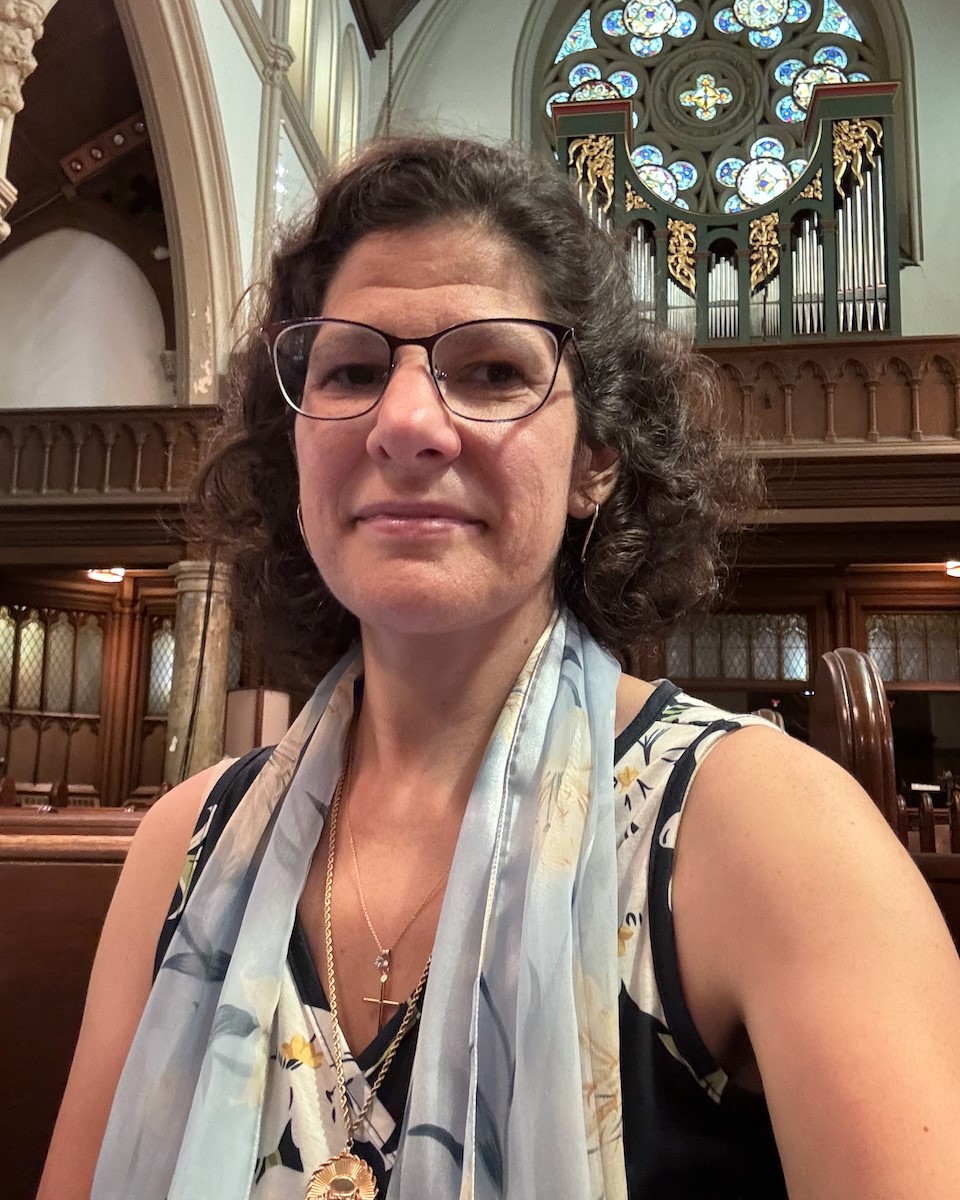
Excuse me. You may. You should recognize and you may very well know Christiane. She is a mother and wife and a musician. She and her husband, the flautist John, have been members of Nassau Presbyterian Church since 2003.
And you were in the choir even before that?
[00:01:44] Speaker B: No, I joined the fire after that. Okay. But I attended since 2000.
[00:01:48] Speaker A: 2000.
She has two lovely children that you have seen up front praying and lighting candles and in pageants and singing.
And now that her children are in school, she's been able to devote some time to musical formation of prayers, devotions and beauty that she is going to share with us this morning. Let's pray.
Lord Jesus, you come to the world as a child.
You come to the world as fresh fallen snow that blankets everything with peace, love and grace.
May that peace, love and grace found in that newborn child fall on us afresh this morning.
In Christ's name we pray. Amen.
[00:02:46] Speaker B: All right, there I am.
So what is the art of the rounded prayer anyway? Well, it's prayer.
And we'll see a little bit more about how that is in the next slide.
Now, is it a round or a canon? I've heard both of these words. Which one is it?
Actually, the canon is the rule or the instruction on how to sing the music. And sometimes that involves what's called an infinite canon, where you get to sing it round and round and round again like row, row, row your boat. Right. Or coming and going and go. Around. But there are other rules that can be used in a canon, and we will see one of those in action.
So I was sending these rounds that I felt were prayers to Noel Werner, and he called them rounded prayers. Thank you, Noel.
And then a teacher back home who I shared these with, she said, move over, Bach, the Art of the Round.
You know, Bach wrote the Art of the Fugue, which is.
So I said, okay, all right.
However, I combined her the Art of the Round with Noel's rounded prayer. And here we are at the Art of the Rounded Prayer.
My guiding principles as I compose both these rounded prayers and in general, Thomas Aquinas is attributed to saying, to sing is to pray twice.
And I have felt that since I was in second grade in Catholic school and creation is a patient search. Le Corbusier was an architect, and that was one of the favorite sayings of my dad, Paul Bessiere, whose other favorite saying no matter what kind of creative endeavor I was pursuing, because I pursued a lot of different creative endeavors. What are you trying to say?
And then finally, God is our refuge and strength, a very present help in trouble. Be still and know that I am God. And for any of you who knew Sue Ellen Page, I am indebted to her for teaching me this passage. And it is near and dear to my heart.
Music Singing in Rounds I have always loved music, especially playing the piano and singing.
Singing has been central to my experience of faith and the divine.
In Catholic school, in the Presbyterian church that, like Dave Davis mentioned last week, we occasionally went to church. Never on Christmas and Easter, but occasionally otherwise.
Until high school, when I went more than my family and I decided to be a musician in the fourth grade. But I didn't yet know what that was going to look like. A pianist, a conductor, a composer. I did get a baton in my stocking in fifth grade.
Singing rounds in particular is foundational to my development as a musician from elementary music school music classes and from a summer music camp that I went to in New Hampshire. In music camp, we learned rounds by rote in evening music and sang them on the tops of the the mountains that we hiked on Saturdays. And here we are at the top of Mount Menadoc.
Without further ado, let us do a little singing and praying together.
I will sing through once Feel free to join as you feel called.
[00:06:37] Speaker C: Rejoice, rejoice Rejoice in the Lord always I will say it again I will say it again Rejoice, rejoice Rejoice in the Lord always I will say it again I Will say it again Rejoice, Rejoice Rejoice in the Lord always.
[00:07:10] Speaker B: I.
[00:07:10] Speaker C: Will say it again I will say it again.
[00:07:15] Speaker B: Very nice. Very nice. This is in your books. If it's easier to read in the paper that you have in your hand than up here.
Should we try to sing this in two part round?
Let's give it a shot. Here we go.
[00:07:28] Speaker C: Rejoice, rejoice Rejoice in the Lord always Rejoice, Rejoice Rejoice in the Lord oh, Rejoice, Rejoice I will say it again Rejoice Rejoice Rejoice in the Lord always I will say it again I will say it again.
[00:08:03] Speaker B: Fabulous, guys.
All right, dad. My greatest champion. I wanted to play the piano like Daddy. And there I am. He's got one of my brothers on his lap. And that's the piano that I started practicing on. Felt like it was forever that I was begging for lessons.
The picture that my dad kept of me in his closet area was from my undergraduate composition recital.
You might recognize this, the composer scarf. If you'd like more information about that, my daughter would be happy to tell you.
And sadly, my final teacher in undergrad made me not want to compose again.
But the Lord had other ideas for me. In 2003, I had.
I felt that I had to say something through music. And I started writing an oratorio, Don Lupis Pacem. And my dad was so proud to capture the beginnings of that. Here I am. I've got the texts written out on note cards.
And it has changed a lot since then. It is not finished, but here's praying that 2026 I will get it done.
He died suddenly on September 25, 2022. Hi, dad.
In grief, I experienced fatigue, heartburn, and ultimately lost my singing voice for almost two years.
My doctor told me the only way through was to emote. And if I could do that through music, all power to me. I didn't have the energy to work on an oratorio. And it wasn't saying what I needed to say for through my grief.
So I started praying all of my sadness and anger at God through writing rounds.
They are small and manageable, right?
And also can be like mantras, you know? I love the Taize services.
My faith suffered for a while in there. I mean, a singer who can't sing. And before my dad had passed, I had nerve issues down my arms. And I was a pianist who couldn't play the piano.
But I kept composing my prayers as rounds, mostly from biblical texts that don nobis Pacem I'd started in 2003 is all about the abiding presence of God through the good, the bad, and the ugly, after all.
So here is one of those rounds that I wrote early on. This one is a little tricky for us to sing, so I have a video for us.
Is the sound going through?
I didn't hear it there. I only heard it here.
Okay, Just a sec.
Still no.
I thought one of the slides. We did have audio. Oh, we did.
Interesting.
The Bach came through. Okay, so maybe it's just. Yeah, it's all the way up there.
H.
That's at the farminary. Yeah.
All right, well, we'll try. We'll see.
[00:11:57] Speaker C: My heart, Sam.
[00:13:10] Speaker B: So that's that. And this one is kind of the flip of that a little bit.
And I was talking about those canons and the rules up at the top there, it says retrograde canon. Without even really being able to read music, you can kind of tell that most of the top line is basically going down and the second line of music is basically going up. In fact, I composed this as a pangram melodically and rhythmically.
So this second line is exactly the backwards version of the top line, and it works.
I'll sing through, and we'll see if we can sing together.
[00:13:57] Speaker C: Weeping may linger for the night.
But joy, Joy comes without dawn.
Weeping malinger for the night.
Joy comes with a dawn.
[00:14:43] Speaker B: Yeah, you want to try to do.
[00:14:45] Speaker C: That a little bit?
[00:14:46] Speaker B: Let's try to see. Let's hear. Let's start with this group this time.
Here we go.
[00:14:53] Speaker C: Weeping may linger for the night.
But weeping thy tongue.
But joy, joy come with Adon.
[00:15:47] Speaker B: Good. I'm going to call somebody out because he's my husband and I can do that. John, could you join this group over here, please?
So, no, we do one and then the other. That's okay. We'll move on for now.
All right. The compositional process, technical practice of writing the rounds and canons. What am I feeling? What am I trying to say? And I choose a text, or I hear a text from Dave or something, and I feel called to set it. I study the text, patterns, lengths of phrases, important words, and I listen for what kind of sound, how many parts, how is this going to kind of work? And the first draft happens on paper, out of my head in my trusty notebook here.
No piano, no computer.
That's where the inspiration happens. And then I find out if I actually put on paper what I had in my head, and I check the technicalities, the counterpoint rules, make sure it works. Put it in a notation program and revise, revise, revise. As my dad said, creation is a patient search. Well, Corbusier said that, but my dad said it a lot. And I composed everywhere. At the farminary, at my daughter's gymnastics class, and in the car on the way to visit family in Memphis while my husband drove.
This is one that I wrote on our back porch.
This is my text. I just had these words running through my head for, like, a couple days.
[00:17:27] Speaker C: I'll sing through Comfort come, peace, Comfort come, peace, Comfort, calm Peace, Comfort come peace Comfort come peace Comfort come peace Comfort come, Comfort come.
[00:18:25] Speaker A: Peace.
[00:18:29] Speaker C: Comfort come.
[00:18:40] Speaker B: Peace.
[00:18:43] Speaker C: Comfort come.
[00:18:54] Speaker B: Peace.
Lovely, lovely.
All right. Practice of writing rounds for others.
Spiritual practice of empathy. A year and a half of writing these rounds for myself had run its course, and I suddenly felt called to give to others some of this comfort that I had received from writing these rounded prayers for myself.
I started asking other folks for texts that were meaningful for them, not as more texts for me to set right, because I just haven't really thought about it, but texts that are meaningful that I would set with that person in mind. What does that person need to hear? What does this. That person? How does that person relate to this particular text? And I'd sit with the text and try to feel an empathic spiritual connection with that other person. This is really a gift for that individual.
What do they need from the music? What do I want to give them?
And then listen and, you know, sometimes listening is hard. I want to just dive in there and write it. But if I really take the time to sit and let the Holy Spirit come through, the Holy Spirit comes through. What does the Holy Spirit want to say through me?
Whenever I get stuck getting too much in my head, returning to that empathic connection with the other person helps me get out of my head and back on track.
This one is written for the inimitable teacher Carol Werheim. And so one of the ways that I wrote it for her was that it could be sung with her students.
So we can sing this one.
I'll sing.
[00:20:52] Speaker C: I can do all things through Christ whose strength and strength and strengthens me I can do all things through Christ who strength and strength and strengthens me I can do all things through Christ who strengthens, strengthens, strengthen, strengthens me I can do all I can do all things through Christ who strengthens me I can do all I can do all things through Christ who strengthens, strengthens, strengthens me.
[00:21:37] Speaker B: Nice.
Is that fun?
Great way to pray, isn't it? All right, the recording process, it's kind of hard to give folks the music on the page and expect them to just pull it off and know what it sounds like.
And also for the rounds that I wrote for myself, a lot of them I have recorded, I use GarageBand. I'm looking to upgrade myself in a little bit, but GarageBand is working quite well. You can see lots of water, my AirPods, the music kind of hiding in the background there.
I create a harmonic structure by picking an instrument that's in GarageBand and setting it up to keep me in time and in tune.
And I record practice tracks to make sure it works. And then if it doesn't, I revise, revise, revise, make edits as I go the recording. And then I record successive parts.
I try to be authentic and record each voice separately on some of the long ones or the big ones, or I wrote one in Hungarian that I use copy and paste.
And then my dedicated husband checks my tuning and I record again and again and again. But you know, as they say, the more you do things, the better you get at them. And my husband will tell you my tuning has improved. I fewer again and again and again and again.
Sometimes I'm working so hard in my head to sing in tune and all the things that I need to return to the empathic connection to bring the joy and love which frees up my body. I just see the person, I'm like, oh, that's such a beautiful person inside and out. And that helps bring it all back.
And sometimes I will add other instruments either that are in GarageBand and I'm branching out with some percussion instruments.
And here we have for Mark around. And this one will have a recording. I don't know if we figured out if there's not alone, but this one, I wrote that it might be fun for him to sing with his youth students, but it's a little bit challenging for us to learn together in the time that we have.
So I do have a recording of this one and I admit that I was unfamiliar with this text and I reached out to Mark and I asked him for his story and just seeing his face as he told me how this text was meaningful to him in his life and his faith journey, then the round just wrote itself.
Oops, sorry.
[00:24:30] Speaker C: For freedom Freedom Rise to set us free.
Rise as set us free for freedom.
Christ is set us free.
Free.
[00:25:51] Speaker B: Thank you very much.
The video process for some of these rounds, as we saw earlier, I like to marry my love of music with my love of color and natural beauty. I take gobs of pictures of beauty all the time. My kids will tell you.
And here's just a little snapshot of my photos app. Lots of clouds and skies and trees.
While I'm making the recording, I often kind of get a feeling for what images I would like to pull together to make a video. Scroll my iphoto library and I assemble the photos and the music in Final Cut Pro.
I upgraded myself a year ago from Apple's imovie.
In here, I was working on a video for Lauren McPheeters.
And here we're gonna. This is a round I wrote for Kim Cleeson and I did create a video to go with it. As I said, I'm really fascinated by clouds these days. And so that first line by so great a cloud of witnesses, I just couldn't help myself.
Absolutely. Yes, yes.
That's Sarah. She was nine days old.
My audio. Thank you.
Excellent. Okay, then play.
Thank you.
[00:27:28] Speaker A: Let's just make sure that's working.
[00:27:29] Speaker B: Okay.
[00:27:31] Speaker C: For freedom.
[00:27:35] Speaker B: Free.
You want to hear that again?
All right, so back through here.
Okay. So the race that is set.
[00:28:03] Speaker C: Since we are surrounded by so great a cloud of witnesses Let us also lay aside every weight, every single sin that clings so closely and let us run with perseverance the race that is set before us since we are surrounded by so great a cloud of witness.
With perseverance. The rios.
[00:30:56] Speaker A: Before.
[00:31:03] Speaker B: I wanted to share. Oh, thank you.
I wanted to share this round for you.
With you. This was for a friend of mine from high school who felt the need made the challenging decision to emigrate with her family for a their safety.
And so I wrote this for her as she was preparing to leave.
She was raised in a non practicing Jewish family. I mean, they did Hanukkah and Passover and stuff, but otherwise her parents weren't really practicing. But she still holds dear her Jewish roots. And then also as an adult, she was baptized in into the Catholic. No, the Episcopal church.
And I connected with her a lot as she made that move for herself. Because when we were in high school, I was Christian, but very strongly looking at Judaism and especially my first year of college, I really looked into it. I had been dating a guy who was Jewish and I love languages, so I learned little bits of the Hebrew. I love the music, I love the food. And also they had this really intense sense of community. Right. Since they're kind of ostracized sometimes. So they have a really intense sense of community. And though my family had been members of a Church since I was in fifth grade, a Presbyterian USA church.
I didn't feel that I belonged and.
And my pastor moved off to different state and I just.
I didn't belong. And I wasn't sure if it was a Presbyterian thing or, you know, what it was. So through college, I investigated a lot. I ultimately clearly came to the conclusion that the Presbyterian blood in my veins. Thank you, granddad. Runs fast and strong, and it wouldn't be authentic to try to be Jewish. Although it still plays a really large role in who I am and my relationship with God and the kind of music that I write.
I've written lots of rounds in Hebrew, and there is a lot of Hebrew in that Don Nobis Pacem that is coming along. So to honor Eden's both and in her faith, I set this in both languages.
[00:34:03] Speaker C: Now and forever.
[00:34:29] Speaker B: Sa.
[00:34:54] Speaker A: Ra.
J.
[00:35:45] Speaker C: Sam so good.
[00:36:13] Speaker B: So I should say that in undergrad, I found I often went to the Methodist church because they had the big choir program like Nassau, but otherwise I went to a small ecumenical church and I sang in that little choir.
But I went in to talk to the pastor one day and I saw on his desk a mug with the Presbyterian USA symbol on it. And it felt like home.
I'm like, no wonder.
And when I shortly thereafter came out here to New Jersey for grad school, I found Nassau. And the first week I was entirely overwhelmed. I went to the second service and I felt very lonely. There were lots of families. I went to the first service, there were lots of families. And I very desperately wanted to be a mom. So that was a little bit hard. But I came back. I went to the second service and I went to George Hunsinger's class. And I felt home and ultimately convinced my now husband, who was finished, who's doing his master's back in Indiana, where we met. I convinced him to move out here because I love the azaleas and I love Nassau.
So in coda, yes, my pencil says, creation is a patient search.
As a composition major, I didn't believe I could do this composing thing.
Doing a thing over and over, as I've said, inevitably leads to growth in confidence and ability. I love doing this work and sharing it with you, and I'm not done.
I'm hoping to create a two volumes of collection of rounds called the Art of the rounded prayer.
In 2003, I knew I had something big to say with my Dono Bispacem, but I didn't believe I could say it well enough. Like Moses, maybe. And I'm finally getting There largely, unfortunately, because my dad died.
My dad always believed in my ability to write music, even when I gave up.
His final gift to me was the Alan and Marilyn Bergman songbook, because he believed I have a gift for setting words. They were a pair, a husband and wife team that wrote a lot of texts for some really famous songwriters.
His passing catapulted me into writing more in a year than I had written my entire undergraduate program, finding joy in sharing my gifts with others and ultimately leading me to believe that I absolutely have to write more music and finish that Don Nobis Pa gem.
Bless you.
God has repeatedly shown me that not only can I do this composing thing, but I am called to share my faith in God's abiding presence and bring beauty and comfort to this hurting world through my music.
[00:39:12] Speaker A: So.
[00:39:12] Speaker B: So before we end, I thought we would end with one that we have all sung. I think everybody has sung this one. The beginning of the services in October.
Join as you feel encouraged.
[00:39:26] Speaker C: What does the Lord require of you?
Of you but to do justice and to love Christ, kindness and to walk humbly Walk humbly with your God what does the Lord require of you?
Of you but to do justice and to love kindness and to walk humbly Walk humbly with your God.
[00:40:24] Speaker B: We'Ll just do two parts. Here we go.
[00:40:27] Speaker C: What does the Lord re.
What does does the Lord require of you?
To do justice worthy of kindness and to walk and to walk humbly with your God what does the Lord require?
What does the Lord require of you?
Of you and to love, kindness and to. Welcome to.
Your God.
[00:41:28] Speaker B: Go.
[00:41:32] Speaker C: Beautiful, everybody.
[00:41:34] Speaker B: Thank you.
Here's where you can find me if you want to listen to more of my music. I have a bunch of videos and more coming on YouTube at keys, pencilstick and soundcloud.
And please feel free to reach out to me if you have a passage that brings you joy, comfort, or helps you get through hard times. Or if you would like to discuss commissioning a larger work with me.
Yes.
Did you write Dona Nobis Pacem? So I did not write the Dona Nobis Pacem that you know.
I am writing a big piece with 10 movements and choir and soloists in which they sing Don Nopis Pacem a lot.
[00:42:22] Speaker C: That's cool.
[00:42:23] Speaker B: Thank you.
Any other questions?
[00:42:29] Speaker A: We do have time for questions, and we hope that you'll feel free to ask.
I had a question. I've been listening to Anonymous 4 and some of these masterful pieces from the early era, early music.
Do you feel like that tradition has made its way into our church and The Presbyterian faith, or is that somehow different from what we celebrate with.
[00:42:58] Speaker B: Well, I feel as though, in our congregation at least, Noel does a really, really wonderful job of bringing in so many different styles of music. Music.
And sharing all of that.
Are you on the road with this presentation?
Noel wants me to be. This is my second time.
Thank you. But you would take it somewhere else if there were? I would.
How long does it take you to compose, on average, one piece, or does it vary? It varies greatly.
Some have just kind of fallen out, as it were, and then there have been a few where I have fought it, and so it fought back. And it's taken weeks and weeks. I'm still working on one for your wife.
And months sometimes. So it really does vary.
[00:43:59] Speaker A: Thank you so much. This is beautiful. And are there contemporary composers of. Of sacred music that are inspirations to you or the particular pieces that have been inspirations?
[00:44:11] Speaker B: If I could have worked with another composer or really talked with another composer, I would have loved to have picked the brain of.
I just lost his name. Paul Rohrem. No, that's Ned Rorem, Minneapolis.
Why did I just lose his name?
[00:44:32] Speaker A: Paulus.
[00:44:33] Speaker B: Yeah. Stephen Paulus. Stephen Paulus.
He was a really fine musician who composed works for church and organ and other things. And I just absolutely love his work.
Unfortunately, he passed.
Will you talk about the Pachelbel Canon and why it's a canon?
So the Pachelbel canon has this repeating baseline, and it's really interesting.
It's not.
It kind of is a canon.
It's got those, like, eight measures that repeat and repeat, and then you just kind of layer on top of it. It's, I guess, a slightly different definition of canon. A cannon on top of a passecalia. A cannon on top of a passicalia.
Thank you, John.
Because canon is easier to say than passecalia.
[00:45:39] Speaker A: You said you like the Taze music.
[00:45:41] Speaker B: I love.
[00:45:42] Speaker A: You have the Taze songbook. And have you spent time with that?
[00:45:46] Speaker B: Yes.
[00:45:46] Speaker A: And have you. Will you go? Have you been to the community?
[00:45:50] Speaker B: So for two and a half years, I worked as the choir director at Heightstown Presbyterian Church. And so, yes, I did get myself a copy of that book. And we used a lot of those pieces because, of course, that was part of what I brought there.
And I went to. There was a service at the Princeton University Chapel, and we just sat and sang them. Oh, it's just. Ah, I was in heaven. And, yes, I would love to go to Taize. I have to wait for my kids to get a little bit older.
It's in France.
The congregation has taken two trips collectively.
[00:46:35] Speaker A: Four or five at this point. The youth program has been twice. The college program has been two or three times.
[00:46:41] Speaker B: Okay. Yeah.
[00:46:42] Speaker A: It's a lovely community, ecumenical community in France that was started after World War II. That is a monastic of some sort community, very musical community. And people visit it from all around the world and Europe, especially during the summers. They'll get thousands of people per week.
[00:47:00] Speaker B: And the music tends to be short and you just sing it over and over and over again at like a mantra, like a meditation.
[00:47:09] Speaker A: Any other questions?
[00:47:11] Speaker B: I was just going to say there is. Every first Sunday night at 7pm every first Sunday night at 7pm the Lawrenceville Presbyterian Church has a tizze service if anyone wants to go. Good to know. Thank you.
[00:47:24] Speaker A: Well, Christiane, we are very grateful to have you in our congregation.
We are grateful for your gift, gifts, for your smile, for your voice. We thank you for sharing with us this morning. Please give me, help me thank her for sharing with us.
[00:47:44] Speaker B: Thank you.
[00:47:48] Speaker A: Again. We invite you next week for our final Journeys of Faith with Sarah Berliner and Stories of Long Faith.